
HBG Designers Select Their Pick of the Trends
HBG Design is on the forefront of the latest ideas in 2023 hospitality and entertainment design. Read our lead designers’ pick of the trends for the year ahead.
HBG ‘Design Thinking’ Contributors:
- Emily Marshall, IIDA, NCIDQ, Principal / Interior Design Director
- Alexandra Milkovich, IIDA, NCIDQ, Associate / Lead Interior Designer
- Landon Shockey, IIDA, NCIDQ, Lead Interior Designer
- Thor Harland. Lead Architectural Designer
Focusing Capital Budgets on Distinctive Amenities and Unexpected Experiences to Attract a Wider Market
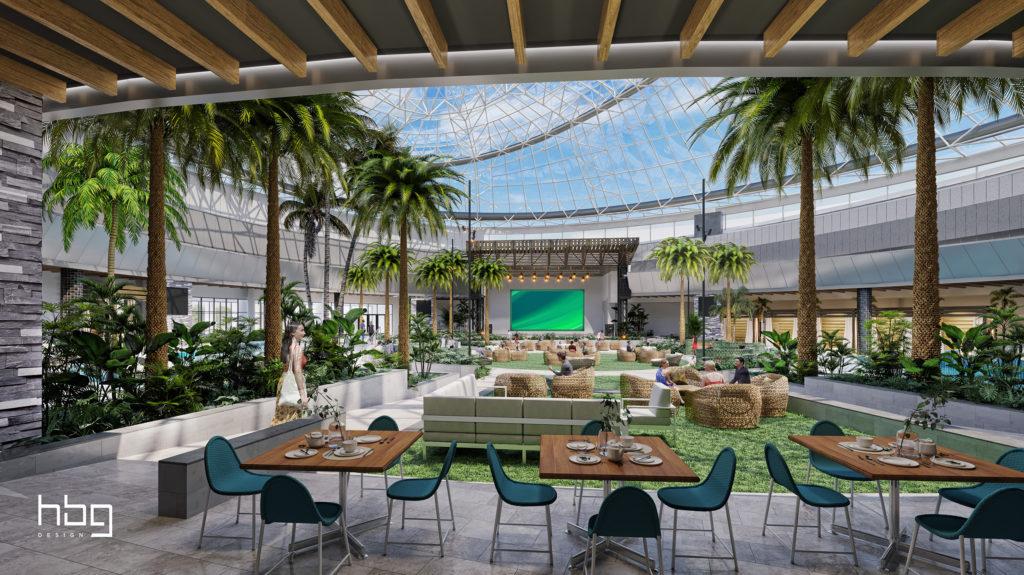
Competition in most markets will continue to be intense in 2023. Properties large and small across the U.S. are elevating competitive advantage by renovating and expanding new market-driven, revenue-generating amenities. Many of our resort clients are betting BIG on unique features to bring in a new untapped customer base from greater distances. “For Gun Lake Casino Resort in Wayland, Michigan, that ‘wow’ factor is a large multi-purpose pool and events complex. The new six-story, 32,000 SF architectural marvel is set to be an oasis for ‘superregional’ customers in Chicago and Detroit looking to escape those harsh Midwest winters,” says Thor Harland. “With a year-round temperature of 82 degrees, The complex is a never-before-seen expansive, mixed-use environment, completely climate-controlled under a stunning glass roof. At its heart are terraced, landscaped pools that transform into a one-of-a-kind event center within the atrium environment. A resort pool by day and a performance complex by night, the concept includes three distinct pools, a swim-up bar, live palm trees and tropical flora, and a large entertainment stage that can host events for up to 2,400 people.”
“We always work closely with our clients and their operations teams to keep project costs down,” says Emily Marshall, IIDA, NCIDQ. “By identifying and eliminating superfluous or unnecessary square footage, we help Owners focus their design budgets on those eye popping, revenue-generating amenities that create visual and experiential distinction in their markets.”
Multi-Functional Hotel Lobbies and Centralized F&B
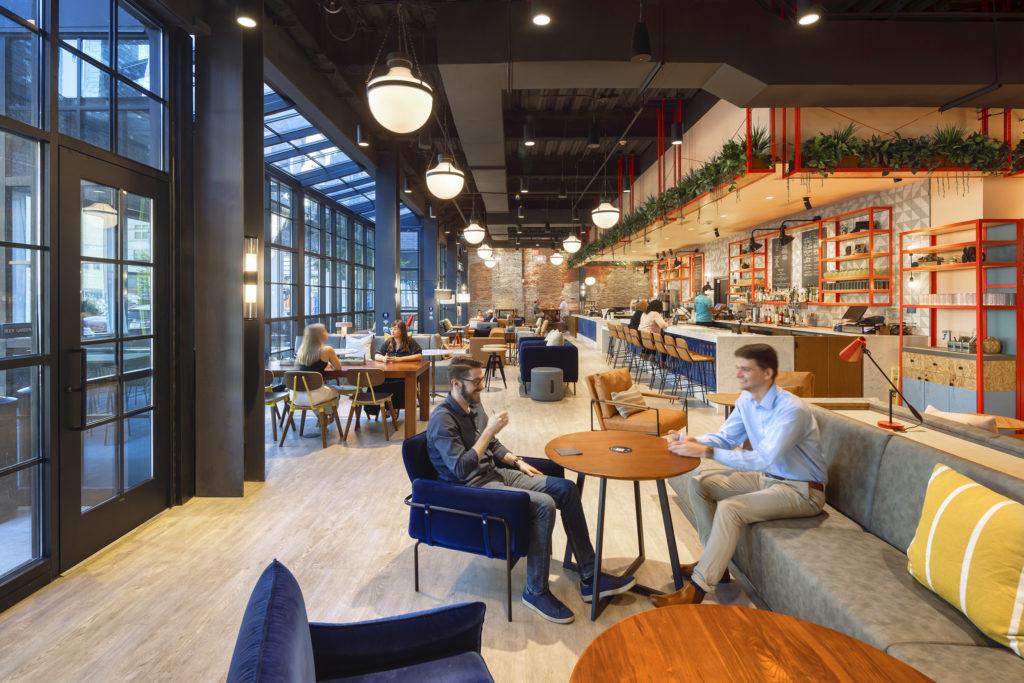
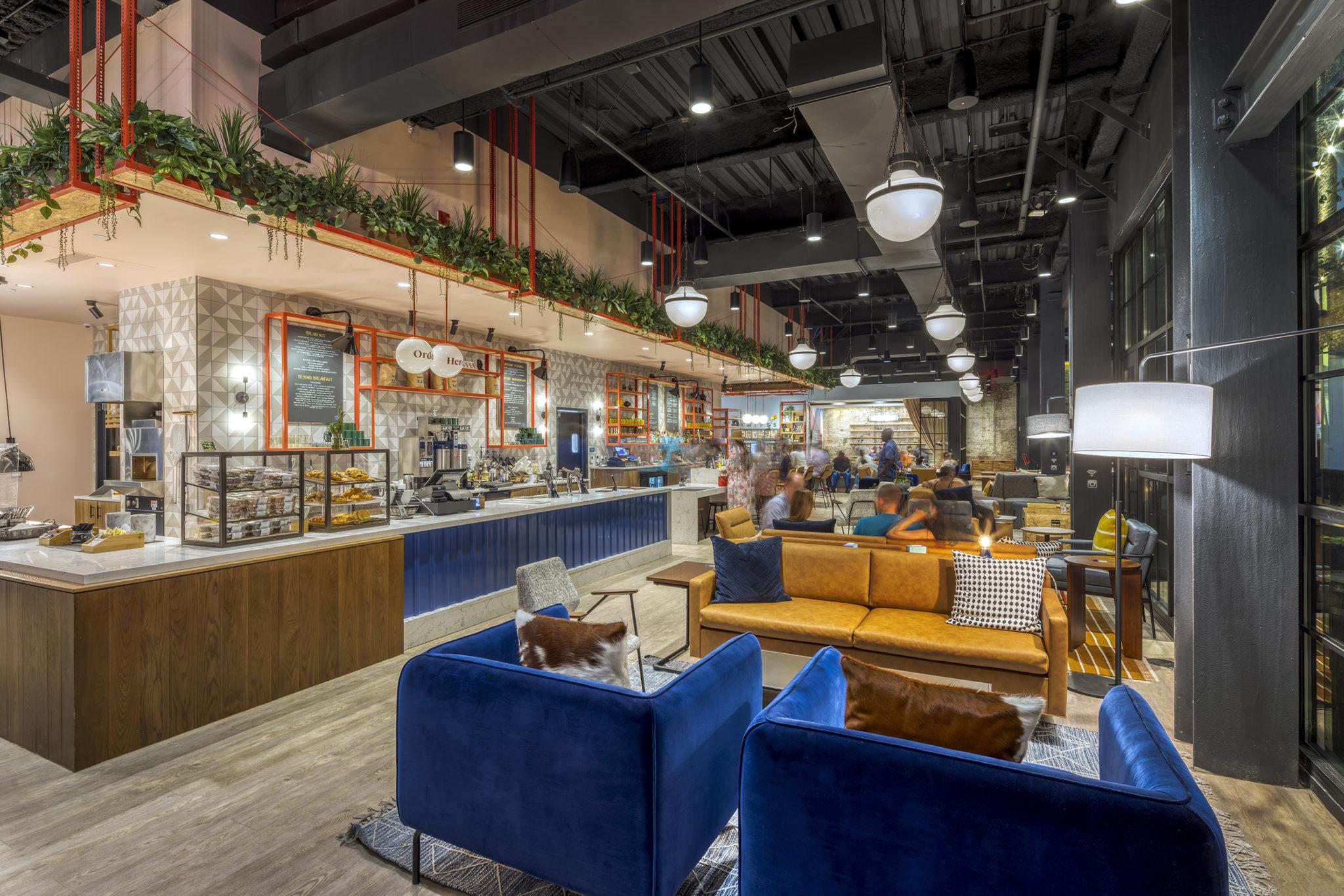
Gone are the days of guests zipping through the lobby as a passageway to other destinations. The new hotel lobby beckons you to sit and stay a while. “Furthering the residential trend that has taken off in the hospitality space, lobbies are appearing more like a comfortable living room – offering a place to eat, drink, work, and play,” says Marshall. The new lobby lounge coined ‘Talk Shop' at Caption by Hyatt Beale Street Memphis reimagines the guest arrival experience with a lively multi-functional welcome area, all-day lounge and workspace, coffee shop, eatery, grab-and-go artisanal market and cocktail bar. “Energy reverberates throughout the colorful space, which was designed to encourage social interaction inside and outside at the adjoining beer garden courtyard,” she adds. Similarly, the adjacent Hyatt Centric Beale Street Hotel’s lobby offers a variety of amenities to suit visitors, locals and remote workers alike, including a large lobby bar and lounge, a communal worktable with integrated outlets and charging stations, a convenient grab and go market, and high-profile dining venue.
“We are also leading changes in F&B design that improves operational efficiency, as a direct outgrowth of the industry’s ongoing staffing shortages,” says Marshall. She explains that menus and food selections may be branded around an experience, but online ordering and room service / delivery / locational pickup means that food preparation no longer needs to be in separate kitchens attached to individual venues.
“Another good example is a property like Resorts World in Las Vegas where food and beverage operations are streamlined by creating centralized, shared hub and spoke type kitchens that service all dining venues on property.” There are many diverse solutions; it all comes down to creating efficiency and functionality that produces high quality with reduced resources.”
Dark, Dramatic, Statement-Making Design
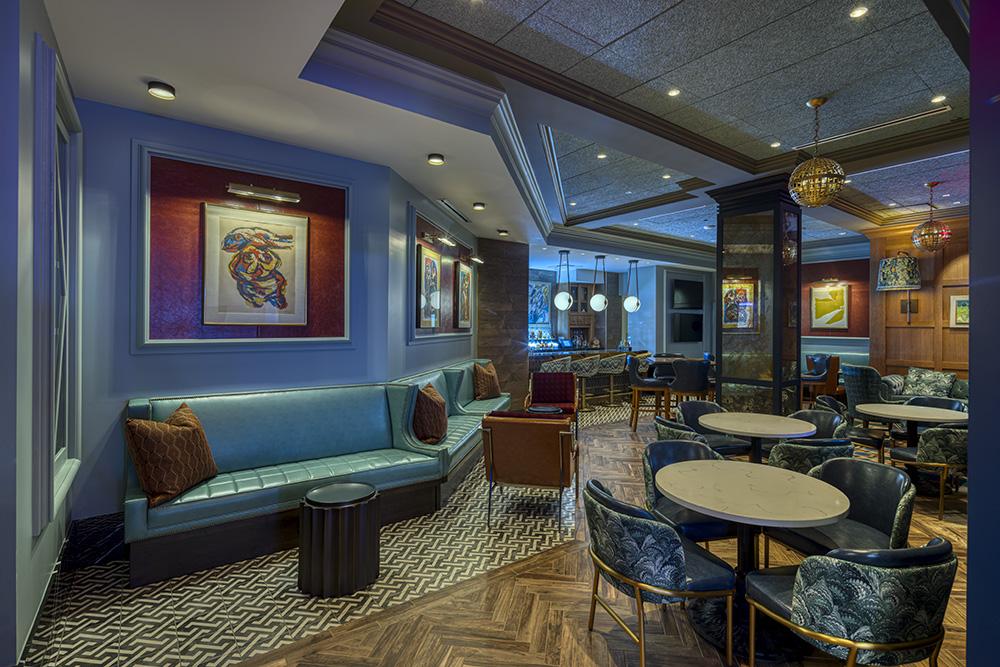
“We are taking bright colors like coral, violet or turquoise and deepening their tonality to create more subdued, rich, darker shades that are visually interesting and restorative,” says Landon Shockey, IIDA, NCIDQ.
The simplicity of white interiors and a minimalist palette is always in style, yet as casino resort designers we LOVE that deep, moody colors are back. One example: The Oak Room at Oaklawn Racing Casino Resort in Hot Springs, Arkansas–a perfect blending of contemporary and traditional design–features an early 1900s era aesthetic reminiscent of a dimly lit, moody speakeasy. The noted F&B venue mixes deep, luxe tones and geometric patterns with brilliantly colored, stunningly energetic LeRoy Neiman original paintings as a playful contrast in the eclectic eatery. Globe pendants, tufted leather banquettes, and custom oak detailing finish the look while transporting guests to a different era.
“Complementing inky hues, we’re blending rich textures like leather, velvet, natural stones, and a variety of woodwork that adds depth and softness which is irresistibly cozy and welcoming,” adds Alexandra Milkovich, IIDA, NCIDQ.
Continued Alignment of Sustainability and Design
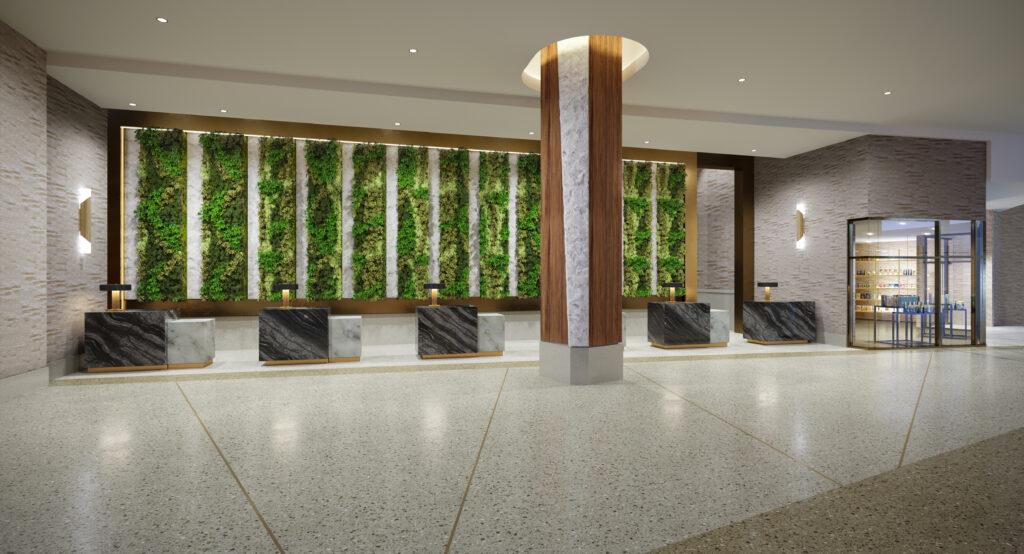
Sustainability is taking center stage these days and major hospitality brands like Hilton, Hyatt, Starwood and Marriott are committing to significantly reducing their environmental footprint in the coming years and focusing on wellness as a key benefit for guests.
“HBG Design is actively aligning our design concepts and interior selections to help clients down this path,” says Milkovich. “Our teams have prioritized sustainable materials in our interiors library and are training designers to select materials for their durability and ease of maintenance and to extend the duration between property refreshes/renovations.”
"Durability leads to a longer lifecycle, especially for furnishings; and the lifetime of a product is something that is extremely important to not only the environment, but also to our client’s bottom line,” adds Milkovich. “For instance, instead of using an exotic wood species such as Mahogany or Walnut that may be overharvested, we would specify Eucalyptus, which is a more renewable species and sustainably sourced. Today’s products made from Eucalyptus can often mimic the appearance of a rarer wood.”
Design That Supports Guest Wellness and Well-Being
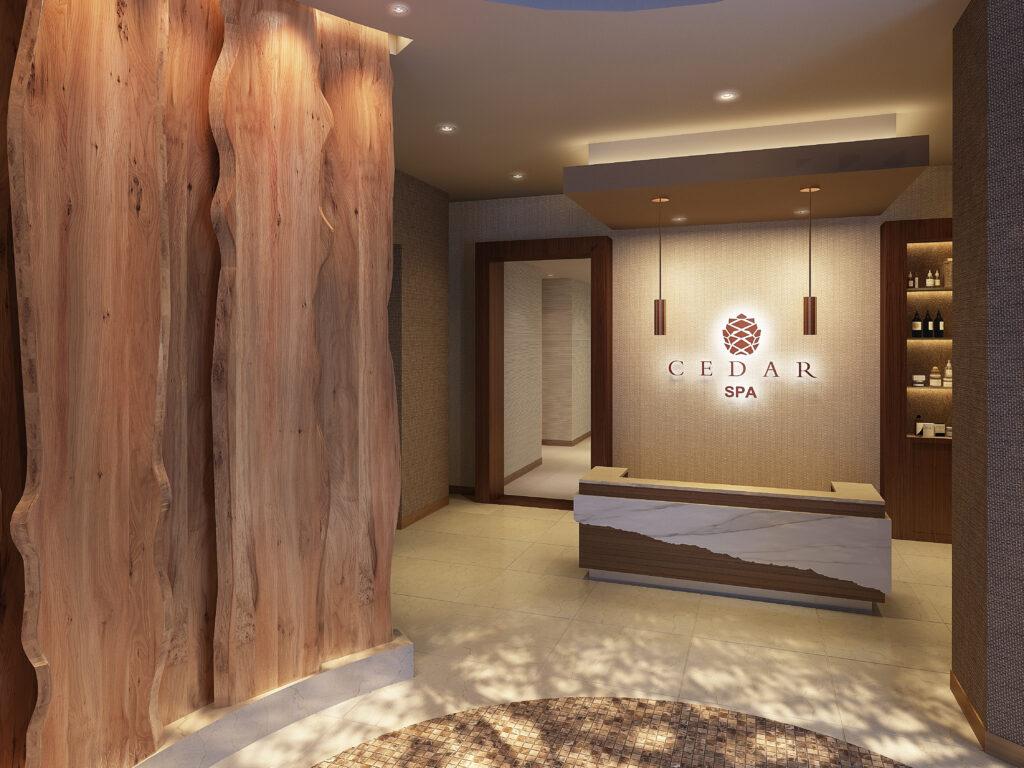
Many of our clients are excited to promote wellness, mindfulness and health benefits among their guests, making spas within the resort environment even more popular today.
“Reduction of stress and increased well-being and healing are some of the overall benefits of biophilic design through the infusion of natural and nature-inspired materials into the built environment,” says Marshall.
The new Cedar Spa at Four Winds Casino Resort in South Bend, Indiana, is a great example of how the demand for wellness is being incorporated into gaming resort properties. At Four Winds, the resort’s signature design elements of copper, cedar, birchwood and stone--each representing significant cultural elements of the Owner’s heritage--are integrated throughout the spa, holistically adding to the wellness experience. Located on the first level of the new 23-story, 317-room hotel tower, The Cedar Spa provides a variety of traditional and unique spa therapies, including steam rooms, saunas, vitality pools and separate lounges for women and men.
“The transition from the high energy zone of the gaming floor to the relaxation zone of the spa is highlighted by an illuminated feature that appears as sunlight shining through a canopy of cedar trees,” adds Marshall. “This simulation was created through ornate copper ceiling elements allowing pockets of light to peek through, creating dancing shadows around the spa entry.”

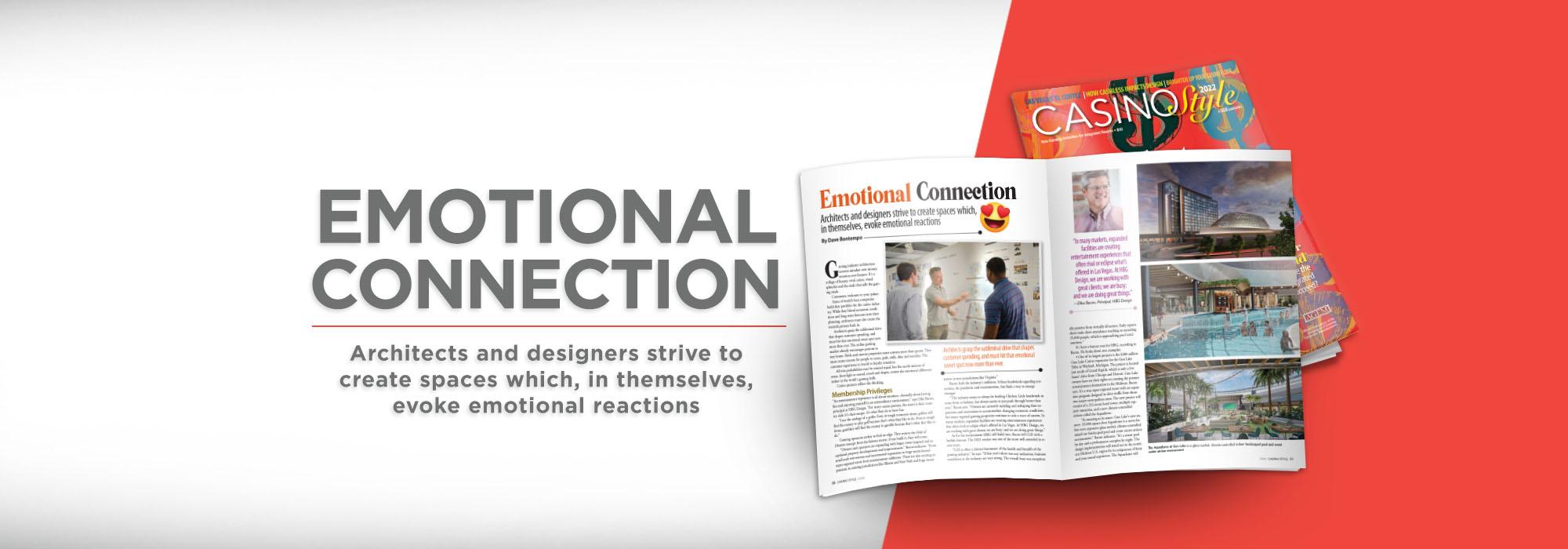
GGB Casino Style Magazine: Designing Emotional Connection
Read how HBG is designing emotional connection into three of our new casino resort projects.
“An entertainment experience is all about emotion—basically about having fun and enjoying yourself in an extraordinary environment,” says Dike Bacon, principal at HBG Design. “For many casino patrons, the resort is their country club. It’s their escape. It’s what they do to have fun.
“I use the analogy of a golfer. Even in tough economic times, golfers will find the money to play golf because that’s what they like to do. Even in tough times, gamblers will find the money to gamble because that’s what they like to do.”
Gaming operators jockey to find an edge. They mirror the Field of Dreams concept from the famous movie: if you build it, they will come.
“Owners and operators are expanding with larger, more targeted and exceptional property developments and improvements,” Bacon indicates. “From small-scale renovations and incremental expansions to huge multi-faceted super-regional resort-level entertainment additions. There are also exciting expansions to existing jurisdictions like Illinois and New York and huge investments in new jurisdictions like Virginia.”
Bacon hails the industry’s resilience. It faces headwinds regarding economics, the pandemic and oversaturation, but finds a way to emerge stronger.
“The industry seems to always be battling Chicken Little headwinds in some form or fashion, but always seems to just push through better than ever,” Bacon says.
“Owners are currently molding and reshaping their expansions and renovations to accommodate changing economic conditions, but many regional gaming properties continue to ride a wave of success. In many markets, expanded facilities are creating entertainment experiences that often rival or eclipse what’s offered in Las Vegas. At HBG Design, we are working with great clients; we are busy; and we are doing great things.”
READ MORE IN GLOBAL GAMING BUSINESS' 2022 CASINO STYLE MAGAZINE
Designing Emotional Connection
Gun Lake Casino Resort, Wayland, Michigan
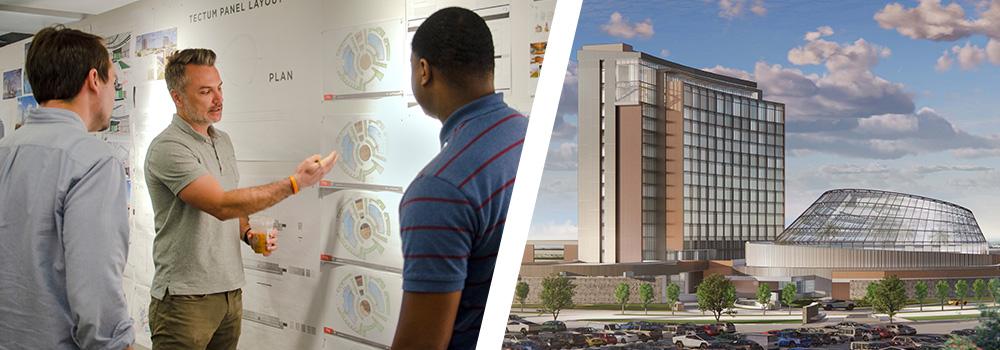
One of HBG Design's largest projects is the $300 million Gun Lake Casino expansion for the Gun Lake Tribe in Wayland, Michigan. The project is located just south of Grand Rapids, which is only a few hours’ drive from Chicago and Detroit. Gun Lake owners have set their sights on creating the premier entertainment destination in the Midwest, Bacon says. It’s a true super-regional resort with an expansion program designed to drive traffic from those two major metropolitan areas. The new project will consist of a 252-room hotel tower, multiple support amenities, and a new climate-controlled atrium pool and events complex.
Rock & Brews Casino, Braman, Oklahoma
The first-ever HBG-designed Rock & Brews Casino and Restaurant owned by Kaw Gaming opened for business in Braman, Oklahoma this year. Co-branding with recognizable names from outside the casino industry to anchor key amenities is not a new concept, but is gaining more traction with tribally owned casinos as a means to broaden market appeal and greater name recognition from an expanding customer base, Bacon says. The 71,000-square-foot gaming project features an expertly curated interactive rock-inspired entertainment experience that only Rock & Brews—and its co-founders Paul Stanley and Gene Simmons of iconic rock band KISS—can provide. The Rock & Brews brand and venues are noted for using heavy integration of rock ‘n’ roll imagery and iconography to elicit emotion and nostalgia in customers.
HBG Debuts the Caption by Hyatt Brand
Introducing Caption by Hyatt Beale Street Memphis:
The First Caption Branded Hotel Built in the World!
Not just in the community, but of the community.
That is Caption by Hyatt’s design promise. The first ever built Caption by Hyatt branded hotel--designed by HBG Design and built in Memphis, Tennessee--fully delivers. The upscale, select-service lifestyle brand introduces a dynamic hospitality experience with an unmistakable neighborhood feel.
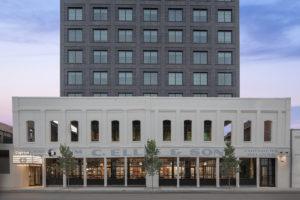
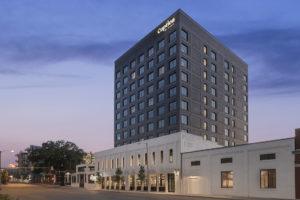
The hotel is housed distinctively within the two-story historic façade of the William C. Ellis & Sons Ironworks and Machine Shop building in downtown Memphis. With its original stenciled building signage intact, the historic Ellis Building was repurposed for the Caption's unique storefront beer garden and first two levels. It also creates the event, conference and meeting space shared by the Caption and the adjacent Hyatt Centric, Built in 1878, this former blacksmith shop was one of the earliest, longest-running businesses in Memphis. It made wrought-iron straps for carriages and shoes for horses and mules and was later used as an agricultural machinery repair shop.
A new 136-room hotel tower rises above, offering guests endless views of the Memphis skyline and the Mississippi River.
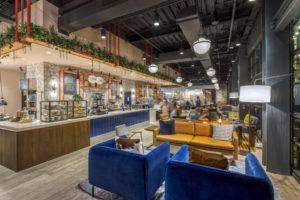
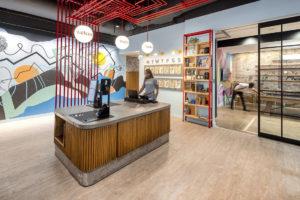
The heart of Caption by Hyatt Beale Street Memphis is ‘Talk Shop’, the brand’s reimagined arrival experience. Here, guests enjoy a lively multi-functional welcome area, all-day lounge and workspace. It features a coffee shop, eatery, grab-and-go artisanal market and cocktail bar. Energy reverberates throughout the colorful space, which was designed to encourage social interaction. It is a place to eat, drink, and connect – inside, and outside at the adjoining beer garden courtyard.
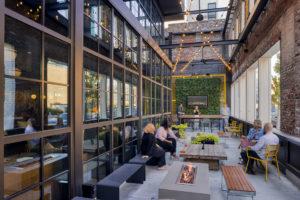
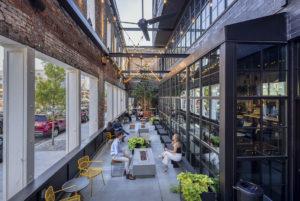
The beer garden is an expansive patio is open to the street’s pedestrian walkway. The space is uniquely integrated within the building’s historic façade and allows guests to fully engage with the active downtown neighborhood.
Click to Read More About the Project
HBG planners and designers created a strong sense of place and a distinct ‘localvore’ urban experience for the Caption by Hyatt and the adjacent Hyatt Centric by drawing conceptual inspiration from Memphis’ rich riverfront industrial history found in the Ellis machine shop buildings, the city’s world-famous musical roots, and the city’s distinct ‘grit and grind’ attitude.
HBG Design Welcomes a New Generation of Leaders
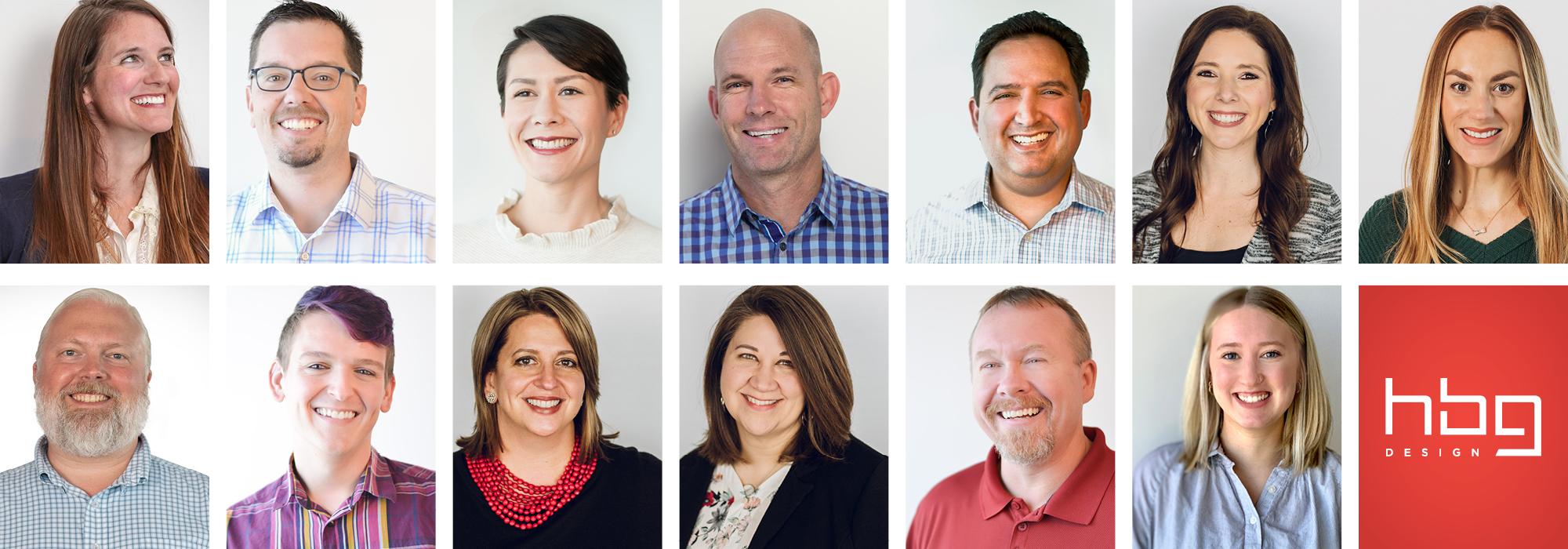
Earlier this year HBG announced the promotion of Nathan Peak, AIA, to Practice Leader. Today, HBG is excited to announce additional promotions and elevations of staff that emphasize the depth and breadth of talent across the span of our entire firm. We welcome these next generation of leaders whose voices are already making an impact on how we operate and practice industry-leading design.
Congratulations to the following HBG Design employees on their recent firm promotions and advancements!
- Deidre Brady, AIA, NCIDQ, LEED AP BD+C, Promoted to Principal / Project Management Leader
- Chris Devine, AIA, Promoted to Senior Associate / Documentation & Specification Leader
- Leslie Thompson, Promoted to Senior Associate / Process Improvement & Resource Leader
- Jason Fox, Promoted to Senior Associate / Construction Administration Leader
- Michael Ochoa, AIA, Project Manager, Promoted to Senior Associate
- Chase Percer, AIA, Associate, Promoted to Design Technology Leader
- Christopher Wood, IIDA, NCIDQ, Interior Designer, Promoted to Associate
- Tamara Goff, CPSM, Principal, Transitioned Role to Director of Communications & Brand Experience
- Dana Ramsey, CPSM, Associate, Promoted to Director of Marketing
- Paul Towery, AIA, ICCC, Senior Associate, Promoted to Codes & Compliance Leader
- Morgan Streitmatter, Promoted to Human Resources Manager
- Patty Sprecco, Promoted to Human Resources Coordinator
- Leah Goodwin, Promoted to Practice Operations Facilitator
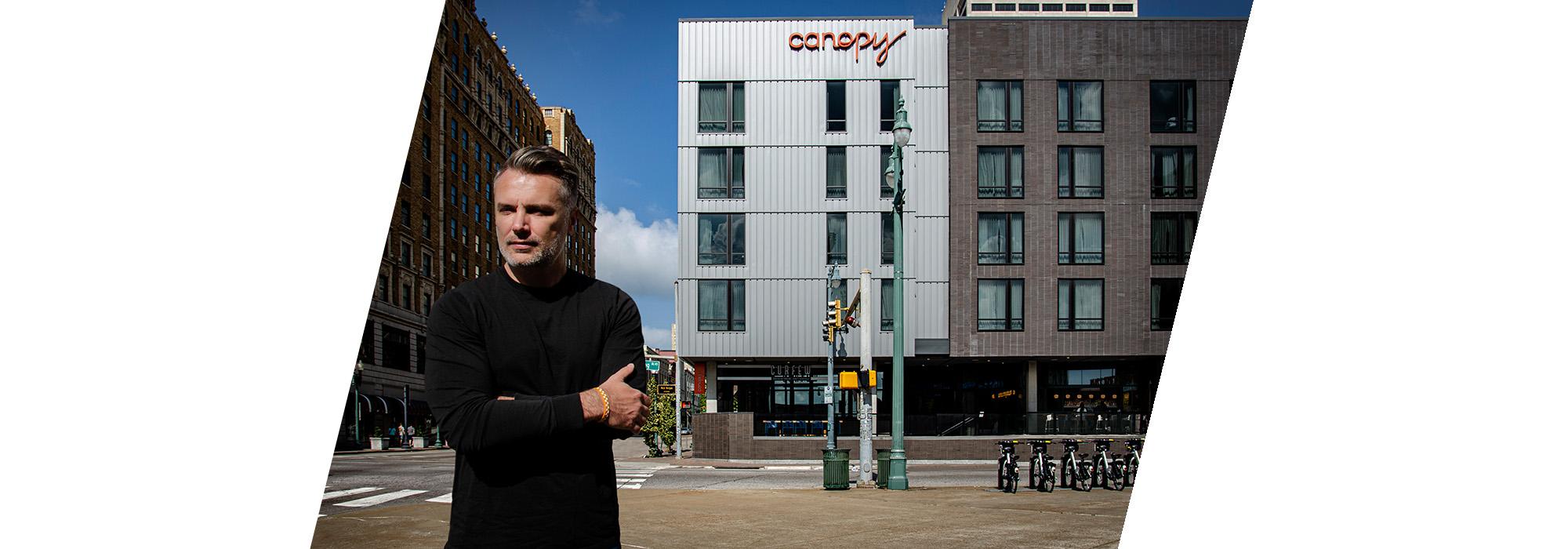
Urban Hotel Design: Embracing the Complication
by Thor Harland, Senior Architectural Designer, HBG Design
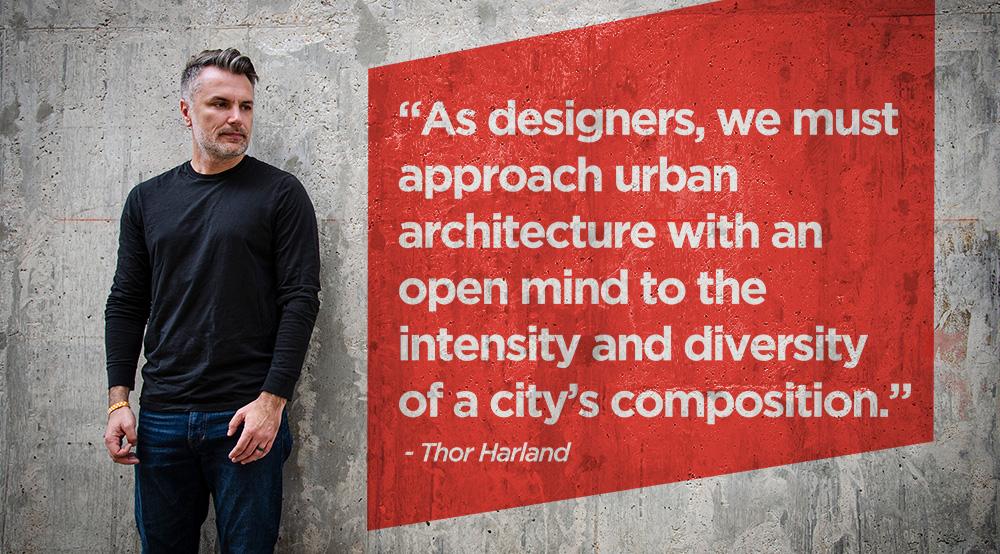
For me, the excitement of urban architecture originates from its inherent complications. It is the limitations and layers of thought that we as designers must critically analyze before introducing new concepts into an already dense city environment.
In most urban settings, available sites for new construction are tightly positioned between existing structures. Each building serves a different user function yet remains connected to the whole. Aesthetics and materiality often vary significantly from building to building, irregular and sometimes raw depending on the age. Some sites retain elements of structures long unused.
New project designs created within the urban framework should be informed by these and other constraints. Historical precedents and environmental context supply ample opportunity to evolve the city’s character.
Our design teams approach these projects with an open mind to the intensity and diversity of a city’s composition. The solutions to these challenges inform the shape, materiality, and function of all new building designs. After all, the more problems a building solves the more value it brings to its surroundings.
In downtown Memphis, Tennessee, three recent hotels designed by HBG Design serve as diverse examples of how a new, evolved design character can reinvigorate the urban landscape bringing immense value to the city collective.
The Canopy by Hilton Downtown Memphis, the Hyatt Centric, and the Caption by Hyatt Beale Street Memphis hotels all represent projects that required thoughtful and rigorous design study to reach their ultimate solutions. Lying vacant for 12 years, the site of a former 50’s era hotel, and a riverside lot with an adjacent 19th century machine shop were each initially viewed as being of limited interest to prospective tenants; some even considered them to be urban blight. Through a new lens, the Canopy, Centric and Caption hotels unveiled opportunities for designers to bring out each building’s individual characteristics and iconic identifiers, ultimately creating enormous community impact.
Canopy by Hilton Downtown Memphis Hotel – Renewing a Gateway Site into Downtown Memphis
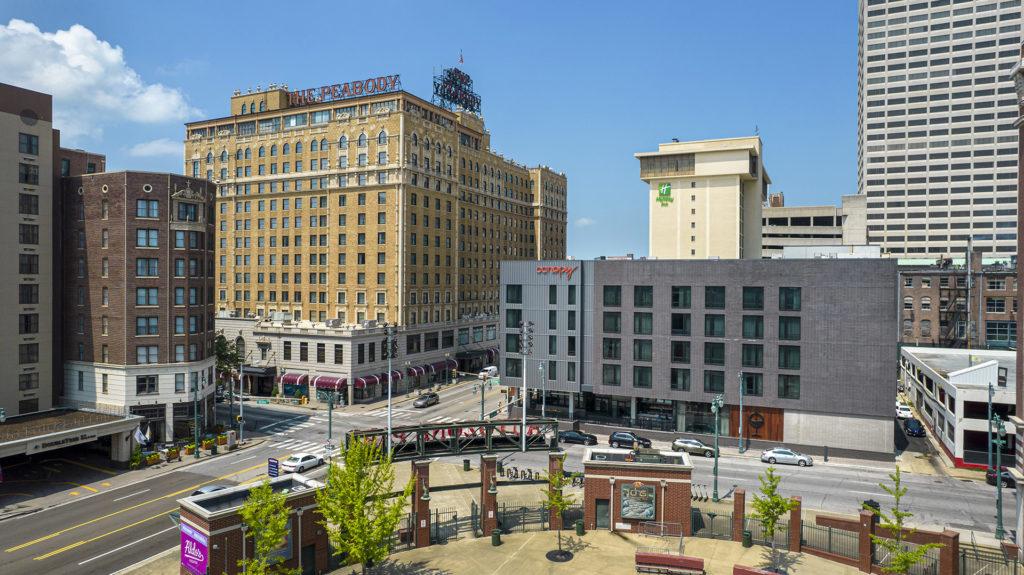
Located at an important gateway into downtown Memphis’ urban center and its historic, world-famous attractions, the Canopy hotel replaced the dilapidated Benchmark Hotel, that was still occupying the site. This corner of Union Ave. and BB King Blvd. is the iconic location of the Peabody Hotel and AutoZone Park, only a few shorts blocks from Beale Street.
The Canopy design and construction was extremely complex to navigate, given the owner’s desire to keep existing building structures and foundations from its previous hotel incarnations. The conflicting structural challenges were ultimately transformed into useful square footage and its solution informed a simplified hotel geometry and a comprehensive expression that created a unique dichotomy between upper and lower floor masses.
The project consists of a 171,100 square foot hotel block elevated above a visually transparent podium level and one level of subterranean parking. The hotel block maximizes the site’s guestroom potential through a double-loaded guestroom corridor ring surrounding an internal light well. A sense of transparency and natural daylighting in the hotel’s base level is achieved through floor to ceiling storefront systems along the South and East edges and two large skylights located under the light well that amplify the restaurant, lounge, and bar amenities.
A Discerningly Rebellious Urban Design, of its Time and Place
To me, great architecture evokes unexpected beauty and resistance but is based in unarguable logic. Through our project visioning, brand interpretation and concepts, the Canopy architecture became less about individual expression and more about amplifying the neighborhood experience in Memphis as the city is today.
The Canopy hotel structure is meant to be a building of its time, and an evolution of Memphis’ downtown personality. We considered the historical precedents and the progressive concept of the Canopy brand; and we used these themes as idea generators for our explorations. The result is a concept that is respectful to place, but also a representation of its contemporary generation.
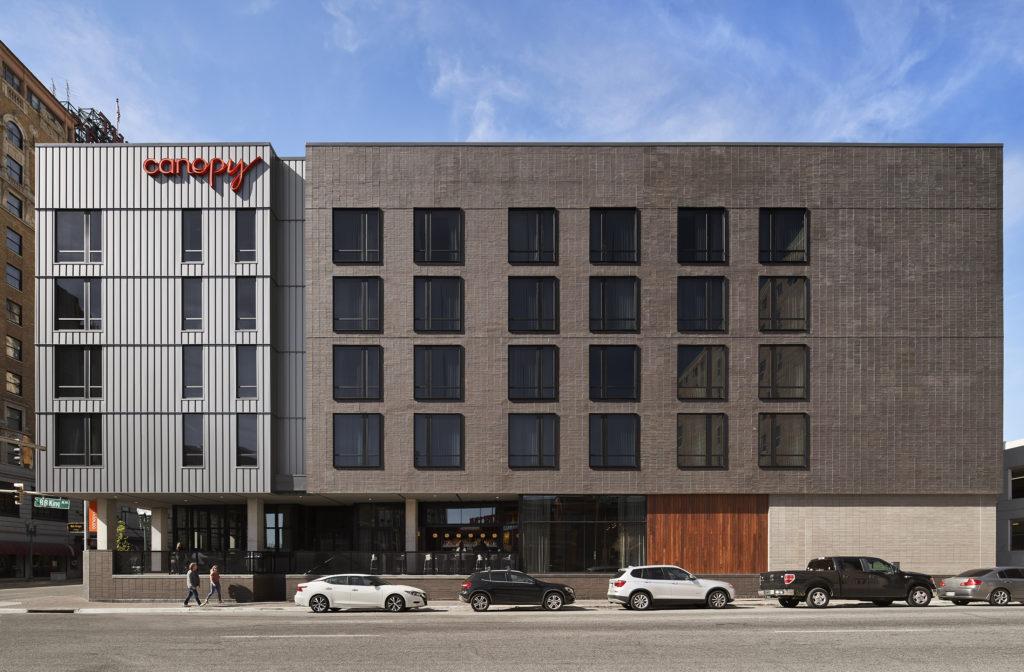
Downtown Memphis architecture has a long industrial history with rows of ornate brick hotel, office and former warehouse buildings lining the urban streets. The materials, proportion, scale and well composed fenestrations of the Canopy are meant to evoke the characteristics of the existing network of mid-rise masonry architecture in the downtown area.
Brick was an important material for continuity, but the size of the brick is slightly different at the Canopy. We used a larger scale brick, and the patterning isn’t a typical running bond; it’s a stacked bond pattern. So, there is some deviation there that helps give the building its own identity. It’s the slight, subtle differences like that and just the overall geometry of the heavy upper floor mass floating above the open public space below that helps to differentiate the design from its neighbors.
A dark charcoal gray palette and simplification of form contemporizes the visual aesthetic of the architecture. It’s discerningly rebellious. I love that an Avant Garde result can be created through rigorous historic, aesthetic, and structural investigation and a direct reaction to the project’s context and objectives.
In the Canopy design, we have produced a unique complement to neighboring buildings, and also a structural acknowledgement of Memphis’ continued evolution as a city with its own intricate personality.
See more Canopy Hotel photos here.
This is part one of two in Thor Harland’s series,
Urban Hotel Design: Embracing the Complication
In part two, Thor and other designers will discuss how Memphis’ One Beale Mixed-Use Development gave rise to a full historic city block of branded hospitality, including the Hyatt Centric, and the Caption by Hyatt Beale Street Memphis hotels.
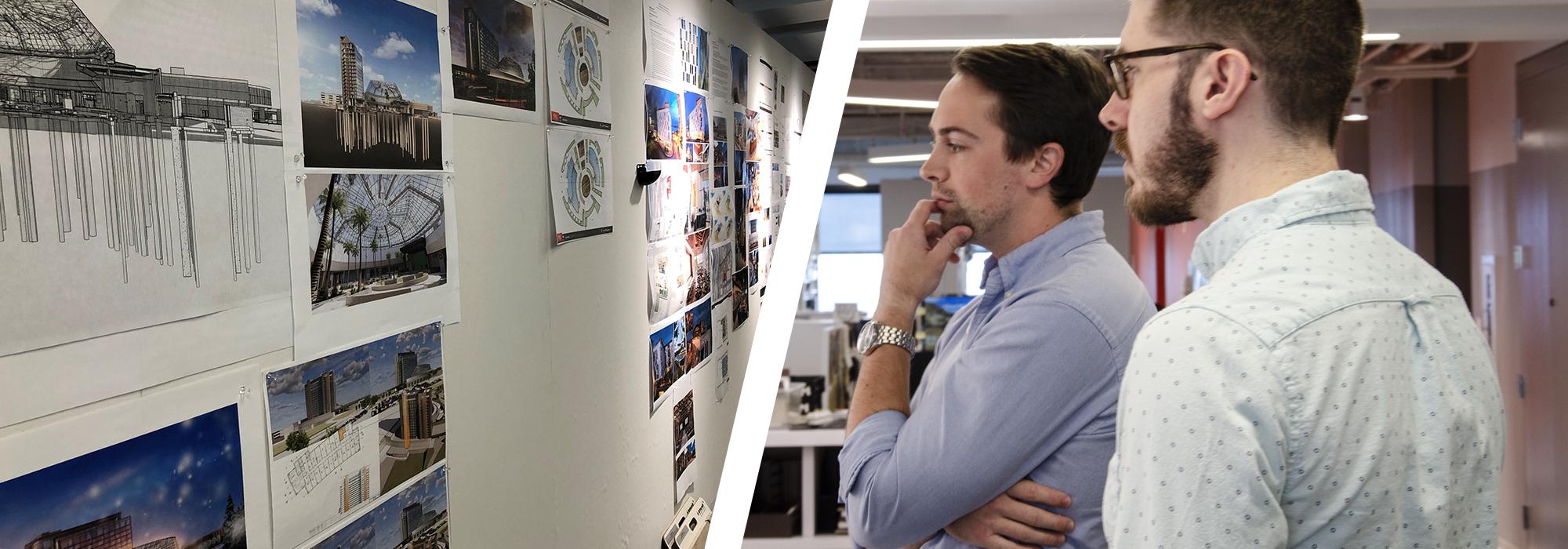
Spotlight on HBG's Emerging Professionals Studio
A discussion with HBG Design’s Emerging Professional Studio (EPS) Leader and recently licensed architect, Ryan Callahan, AIA
Ryan, as the new leader of HBG’s Emerging Professionals Studio (EPS), can you give us some background on the program?
While my involvement in the Emerging Professionals Studio began five years ago, HBG Design’s EPS program was conceived about 15 years ago as a group led "by EPs for EPs", providing opportunities for leadership experience within the firm at an early career stage.
The EPS originally focused on helping emerging architecture professionals through the AXP architecture licensure process and also provided opportunities for team building. The program has evolved to serve expanded EP career needs, including welcoming HBG’s interior designers into NCIDQ licensure study while also focusing on individual leadership development.
As a practice that integrates architecture and interior design to create hospitality design experiences, it was imperative that the EP Studio evolve to support the way our firm works and collaborates. Architects and interior designers have different licensure requirements and different ways we approach a project based on the nature of our disciplines, but we share similar goals and many commonalities, which are incorporated in the EPS program.
Our EPS today is rooted in the idea that emerging professionals desire structure in working towards licensure, but also want the flexibility to easily modify the pace of their journey as their personal or professional life changes. Mentors play a key role in helping EPs find their path individually and as a group, actively developing support strategies and needed resources for licensure in ways that matter most to each individual in their particular stage of development.

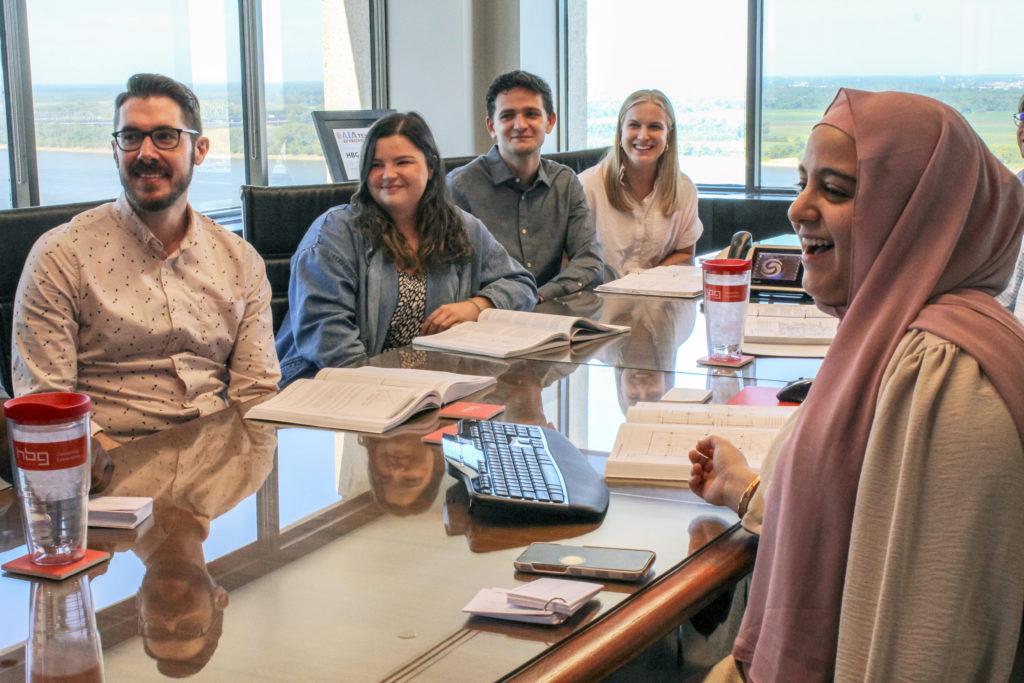
How did you become a leader of EPS?
I had just passed my remaining Architectural Registration Exams (AREs) a few months before Nathan [Peak, HBG’s Practice Leader] asked me to lead the EPS group. I think he asked me specifically because I was newly licensed, but also because I was part of HBG’s pre-Covid EPS program culture. As our workplace returned to the office, we all wanted to find ways to reengage our EPs into a group-learning mindset and provide the kind of supportive group environment that we had before the pandemic, and had been missing for over two+ years. Covid was so disruptive to everything, to the way we do things, even to my own growth. I entered and came out of Covid in a different phase of life. A lot of things changed. For example, I was just newly married entering Covid. When we went into work-from-home mode during this weird, sort of hyperbolic isolation, I came back to the office as the father of two boys. Now, I’m more aware of the level of involvement that people in different stages of life can have after work hours, but I’m also more focused.
And, of course, I could not lead EPS without others. In our Memphis office, Chris Wood is co-leading on the interior design side. And in our San Diego office, architect Nathan Blair and interior designer Alexandra Milkovich are leading the local EPS activities.
How has the EPS changed since you started?
For the first two years of my involvement in EPS, we had about 20-30 EPS members. It seemed like our EPS culture revolved around in-person knowledge exchange forums, recreational sports, and group learning activities. Of course, the pandemic changed everything, and put a damper on group events. We are now recapturing that level of camaraderie and have a great EPS group and supportive firm culture. I am seeing our group involvement increase every month.
The “work-from-home era” did teach us how to become more technologically resourceful and interconnected across distances. With more variety of tools enabling us to work virtually, we were able to put study information at each EP’s fingertips. All HBG’s EPS study information was organized, cataloged by topic, and made accessible through our MS Teams cloud-sharing platform. I’m proud to say we didn’t let the pandemic become a huge obstacle to getting our EPs help. For me, the biggest hurdle was just getting started.
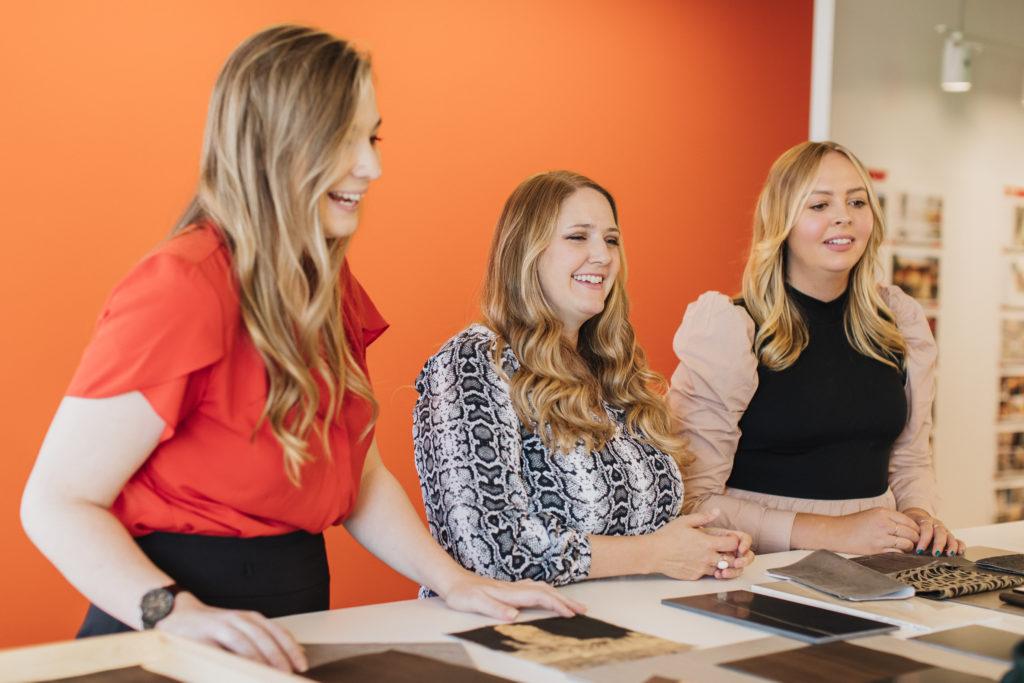 The “work-from-home era” did teach us how to become more technologically resourceful and interconnected across distances. With more variety of tools enabling us to work virtually, we were able to put study information at each EP’s fingertips. All HBG’s EPS study information was organized, cataloged by topic, and made accessible through our MS Teams cloud-sharing platform. I’m proud to say we didn’t let the pandemic become a huge obstacle to getting our EPs help. For me, the biggest hurdle was just getting started.
What’s new for the EPS at HBG Design?
EPS leadership has also been developing onboarding courses to help new hires become fully engrained and fluent in HBG’s design processes. This is the information they didn’t and couldn’t learn in school.
This is a bit like HBG’s version of the NCARB AXP program re-formatted into a series of lessons from seasoned professionals at the firm who each offer over 20 years of industry experience. These seasoned professionals lead regular meetings to share topics on the firm’s building processes ranging from codes to life-safety; space planning to hospitality design to sustainability to construction detailing - all supporting knowledge sharing and the path to licensure through ARE, NCIDQ and LEED testing.
“Knowledge of how something is constructed is very valuable. It doesn’t matter if you are selecting a finish or drawing a wall or designing a building. If you know how it goes together, it goes together better,” says Ryan.
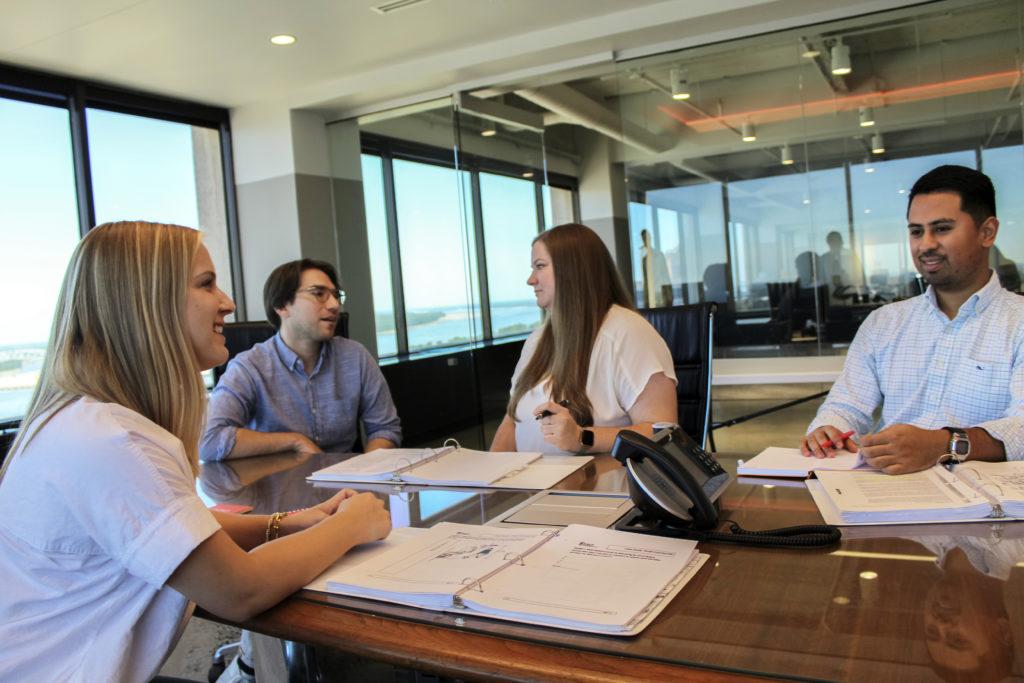 Knocking out AXP experience hours quickly is everyone’s goal when they get out of school, because there are a lot of hours required! EPS continues to coordinate supplemental training, quarterly site visits/project tours, exam study sessions, and professional engagement with design industry organizations. And our project staffing tracks EPs who are actively pursuing licensure to connect them with needed AXP hours.
How are EPS participants given a voice?
Everyone in the EPS group is empowered to initiate a discussion, lead an event or portions of a group project, or given freedom to implement a new process they feel passionate about and that will lead to growth of their peers and colleagues.
Weekly ‘Coffee + Collaboration’ mornings offer an all-employee open platform to initiate design discussions based on active project reviews to help inform the general direction of design or seek input on how current projects could be improved. EPs and student interns work together as valued project team members, gaining exposure to design challenges as well as opportunities to exchange ideas. They get a lot of encouragement to add their input in project design critiques in an environment where every voice is respected. This adds to EP’s experience in acquiring increasing levels of hands-on design leadership and really finding their voice.
We also have a number of international AIA members and EPS gives them a road map to licensure in the U.S. after becoming licensed in another country. The EPS is really benefiting from the variety of viewpoints and experiences of our EPS members. They each bring different approaches and well-rounded perspectives to the group.
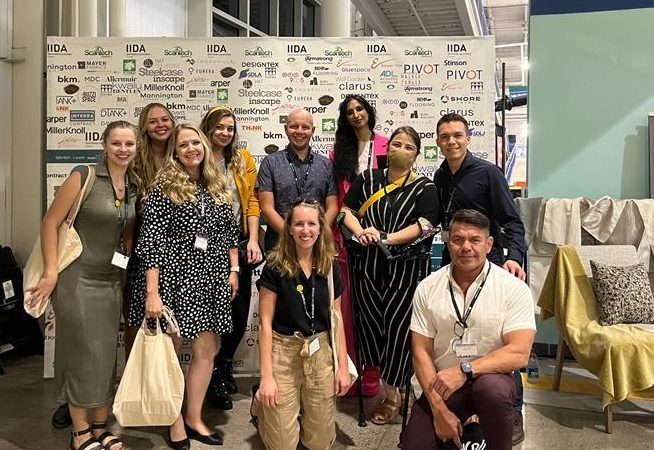
Is EPS all business?
Career fulfillment is heavily dependent on engagement with co-workers. Now that we are MOSTLY out from under the pandemic, I think it’s important for the EPS to continue promoting relationship building and providing bonding opportunities among co-workers and within the EPS. These group experiences build an authentic sense of camaraderie that builds trust and makes the work experience much more inspiring and positive.
From painting parties to kick-ball and indoor soccer teams; group nights and happy hours at new restaurants to family-centered outings, EPS is actively improving our post-Covid in-person firm culture and making the firm a stronger, more dynamic organization.
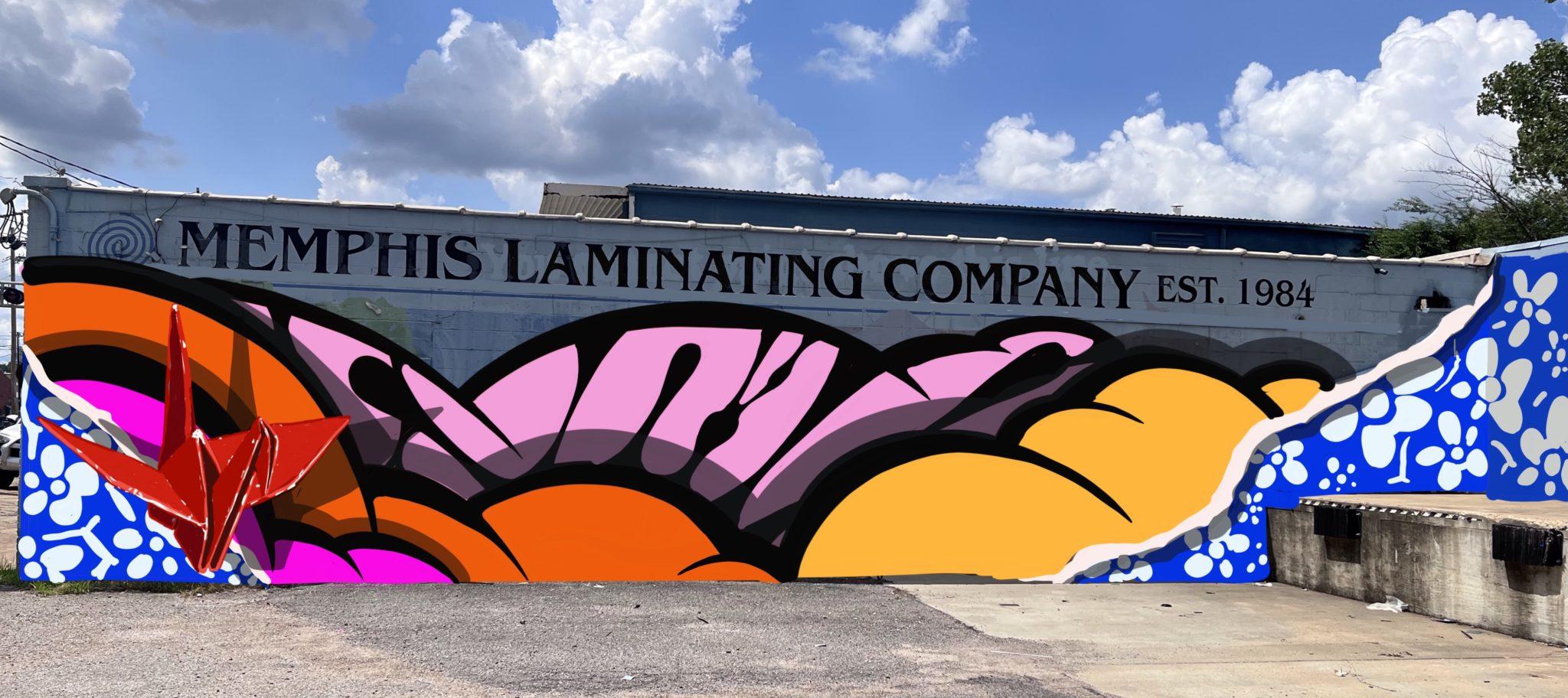
HBG Sponsors 2022 Paint Memphis Mural Arts Festival
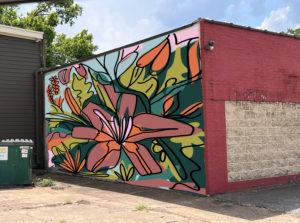 HBG Sponsors Paint Memphis Festival: HBG Design is excited to share the relaunch of our Kirk Bobo Creating Impact Grant & Volunteer Program, and announce our 2022 community partner, Paint Memphis!
We will be kicking off our volunteer activities at the 2022 Paint Memphis Festival, a fun and creative event designed to animate the Broad Avenue Arts District through the creation of public building mural art.
Read more about the community-friendly festival event below and come out to experience the day’s excitement.
A Painted Broad:
The 2022 Paint Memphis Festival on October 8 in the Broad Avenue Arts District will make mural art beautification a community experience.
Media Contact: Karen B. Golightly, Paint Memphis, 901-275-1981, [email protected]
Ever been curious about the vibrant building murals popping up all over Memphis, seemingly overnight? The 2022 Paint Memphis Festival will demystify the mural art process during their one-day community painting event in the Broad Avenue Arts District on Saturday, October 8, from noon to 6 p.m. It’s going to be an immersive, creative, and family-friendly experience, fully open to the public.
Over 150 local and regional artists will converge to show off their talents and connect with the community in the making of the largest collaborative mural art event in Tennessee. The festival is also expecting special regional guest artists to include the Carpenter Art Garden, Houston High School, the Girl Scouts Heart of the South Council, and Christian Brothers University.
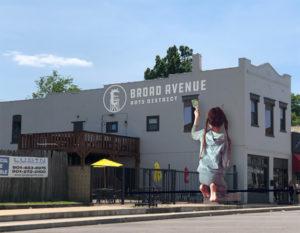 “Expanding on Broad Avenue’s clever redevelopment tagline, “A New Face for an Old Broad,” our festival artists are giving a colorful facelift to several of the buildings on Hollywood, Broad, Bingham, and Scott Streets,” says Karen B. Golightly, Executive Director and Founder of Paint Memphis. “We want the public to be part of this artistic endeavor, to meet the artists and take part in enhancing the neighborhood, during a day of work (for us), art appreciation, learning, and entertainment.”
Over 50 vendors and food trucks, and a children’s hands-on makers space, will engage artists and art lovers of all ages. Several demonstrations and workshops are planned to help involve the community in the creative process, including:
- A hands-on mural workshop by Zulu Artist
- A skateboarding workshop by Society Memphis
- Performances by Memphis Hoopers and the Kumar Indian Dance Troop
- Live painting by local, national, and international artists.
New this year are corresponding gallery shows by over 100 of the participating festival artists, to be held at some of Broad Avenue’s finest businesses on Friday, October 7, 5-8 pm.
All mural art will be family and community friendly. Designed to spread positivity, Paint Memphis has set up beautification guidelines for the murals.
“No nudity, no profanity, no drug or gang imagery, nothing political, and most importantly, no zombies,” states Golightly. “We’ve gathered input from the neighbors through door-to-door and online surveys, and our artists are great at listening to public wishes to create art that will enrich our neighborhood spaces.”
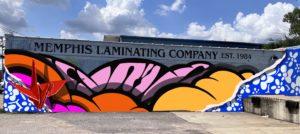 Paint Memphis is a 501(C)3 organization that paints large collaborative murals involving local and national artists. Since 2015, Paint Memphis’ one-day paint festival has produced the best street and fine art in the South. The organization welcomes all types of artists of all skill levels and styles. Their diverse artist base donates time and talent each year to the mission to turn blight into art.
Learn more at PaintMemphis.org
And check out the artists at www.instagram.com/paint_memphis/
Read about HBG Design's previous Creating Impact Grant and Volunteer Program projects.
HBG Design Ranks 'Top 10' with BD&C
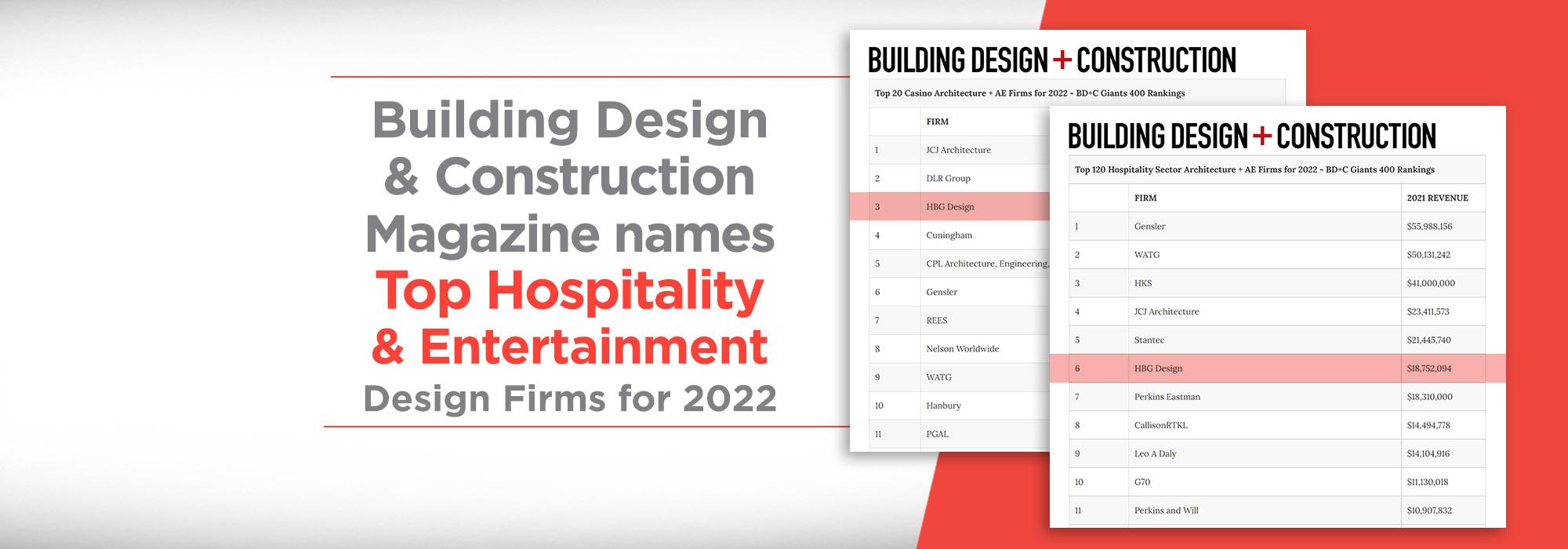
We are excited to announce our placements in Building Design & Construction Magazine's Top Hospitality and Entertainment Design Firms List for 2022:
HBG Design is #6 on list of Top 120 Hospitality Sector Architecture + AE Firms for 2022, BD&C Magazine!
and
HBG Design is #3 on list of Top 20 Casino Architecture + AE Firms for 2022, BD&C Magazine!

Gun Lake Expansion inspired by the sun’s path in the sky
Hospitality and entertainment design firm HBG Design is helming the design of Michigan's new Gun Lake Casino Expansion – a glass-roofed, climate-controlled, indoor landscaped pool and event centre atrium environment.
Read the full article here at CLAD magazine.
BY MEGAN WHITBY | 12 SEP 2022
The six-storey, 32,000sq ft Gun Lake Expansion is part of a US$300m (£259.1m, €298.4m) site-wide overhaul of the casino. The investment is also funding the construction of a 252-room hotel and further entertainment amenities.
“The [expansion] is sure to become a must-see feature,” said Paul Bell, AIA, principal at HBG Design.
“A resort pool by day and performance complex by night, the glass-enclosed circular structure will generate an immense sense of energy inside and out, while offering a variety of complementary entertainment and gathering opportunities for resort guests and entertainment-seekers.”
With a balmy 82℉ (27.7°C) year-round interior climate, the [expansion] will be home to three pools (family, age 21 and over and VIP), pool cabanas, an outdoor patio with a fireplace, a swim-up bar, semi-private nooks wrapped around a central lawn and bars and concessions.
The building’s glass roof structure will be sculpted and modelled by the sun’s daily path across the site and provide a window to the sky throughout the seasons.
HBG Design says the roof’s multi-layered composition has been designed for function and efficiency.
“The targeted high-performance glazing and the atrium’s space frame structure will combine to create the distinguishing sloped oval shape that maximises and filters natural light from solstice to solstice,” says Thor Harland, lead architectural designer at HBG Design.
“From there, the base structure will be a mix of materiality that accommodates the variety of amenities within.”
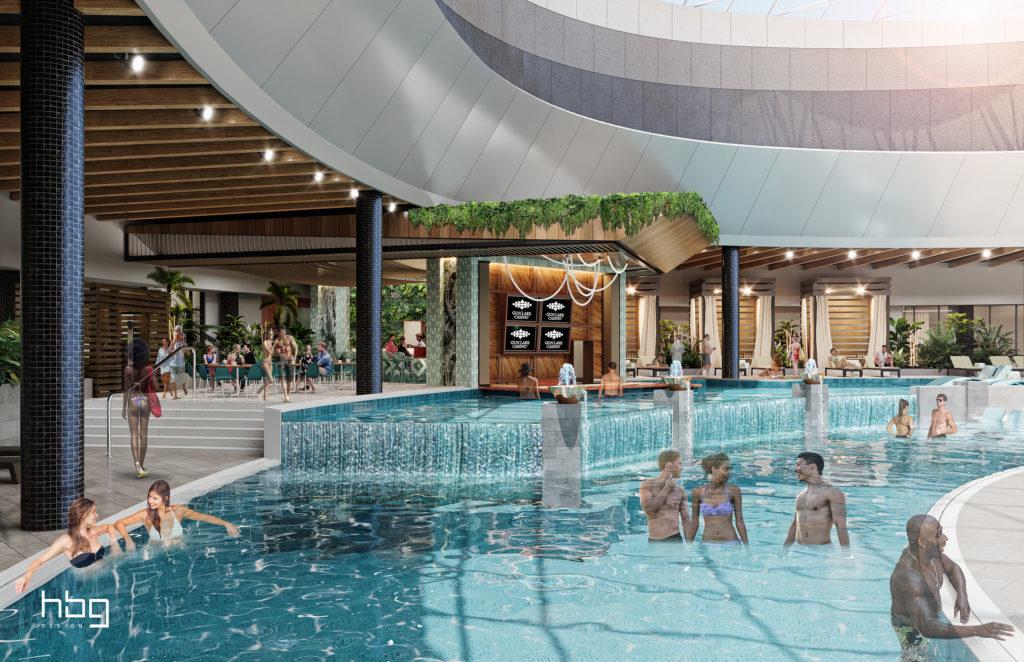
Offering year-round entertainment, the interior pool and event space will hold an immersive multi-level landscaped pool environment.
The [structure] will also transform into a concert venue, banquet centre and entertainment venue capable of hosting large events with a 2,400-person capacity. Seating will be able to be configured around water features in a variety of arrangements.
Functional and decorative acoustical panelling will be integrated aesthetically into the design to enhance and regulate sound during live performances.
Plus, a temporary yet dramatic installation of flex acoustics will be suspended about 40 feet above the stage for further sound control, depending on the type of performance.
“Without question, the design attributes will create a first-class destination resort and a highly unique entertainment experience,” said Gun Lake Casino CEO, Sal Semola.
“This is just the next step towards making our property the premier entertainment destination in the Midwest.”
Construction of the hotel and events expansion began in late May 2022.
Article also published in Attractions Management magazine here.
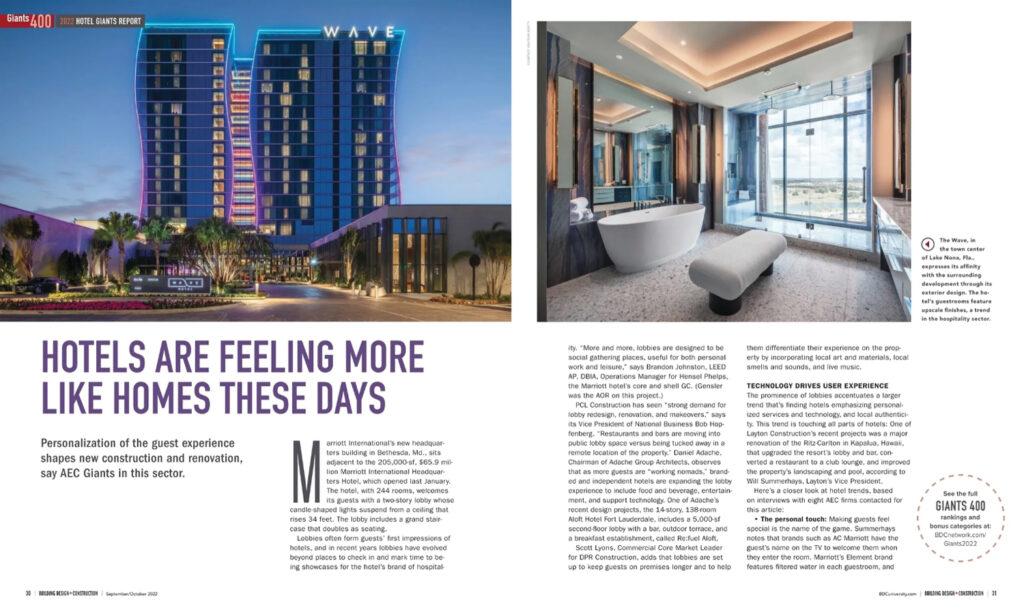
BD+C's "Hotel design trends for 2022-2023"
Hotels are feeling more like home these days...
Personalization of the hotel guest experience shapes new construction and renovation and hotel design trends in 2022-2023, say architects and construction experts in this sector.
Read the full article in Building Design + Construction magazine
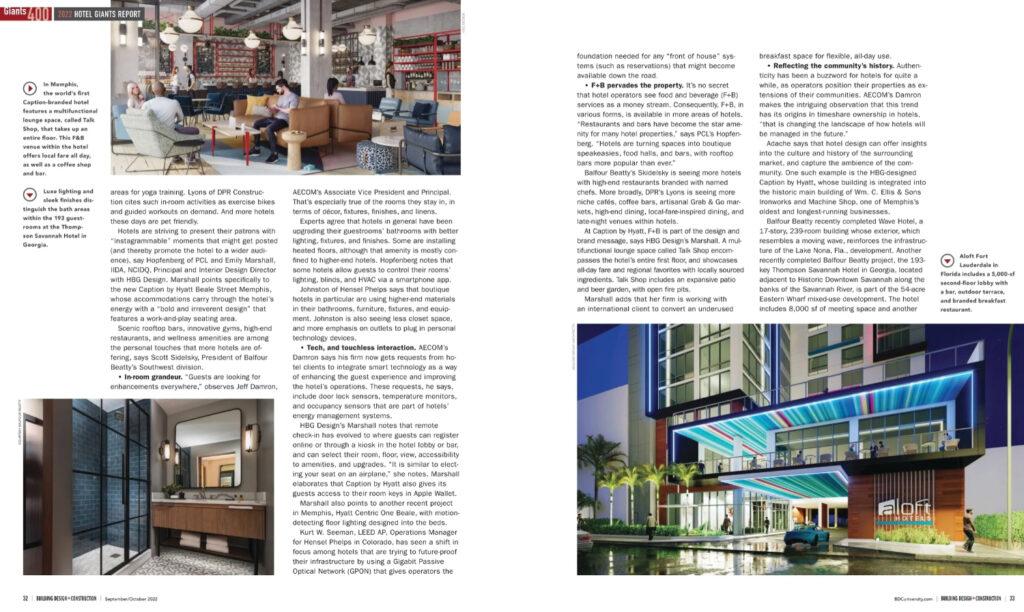
Excerpts from the "Hotel Design 2022-2023" article featuring HBG Design Principal and Interior Design Leader, Emily Marshall, IIDA, NCIDQ:
The personal touch: Making guests feel special is the name of the game.
Hotels are striving to present their patrons with “Instagrammable” moments that might get posted (and thereby promote the hotel to a wider audience), says Emily Marshall, IIDA, NCIDQ, Principal and Interior Design Director with HBG Design. Marshall points specifically to the new Caption by Hyatt Beale Street Memphis, whose accommodations carry through the hotel’s energy with a “bold and irreverent design” that features a work-and-play seating area.
Tech, and touchless interaction.
HBG Design’s Marshall notes that remote check-in has evolved to where guests can register online or through a kiosk in the hotel lobby or bar, and can select their room, floor, view, accessibility to amenities, and upgrades. “It is similar to electing your seat on an airplane,” she notes. Marshall elaborates that Caption by Hyatt also gives its guests access to their room keys in Apple Wallet.
Marshall also points to another recent project in Memphis, Hyatt Centric One Beale, with motion-detecting floor lighting designed into the beds.
F+B pervades the property.
At Caption by Hyatt, F+B is part of the design and brand message, says HBG Design’s Marshall. A multifunctional lounge space called Talk Shop encompasses the hotel’s entire first floor, and showcases all-day fare and regional favorites with locally sourced ingredients. Talk Shop includes an expansive patio and beer garden, with open fire pits.
Marshall adds that her firm is working with an international client to convert an underused breakfast space for flexible, all-day use.
Reflecting the community’s history.
Hotel design can offer insights into the culture and history of the surrounding market, and capture the ambience of the community. One such example is the HBG-designed Caption by Hyatt, whose building is integrated into the historic main building of Wm. C. Ellis & Sons Ironworks and Machine Shop, one of Memphis’s oldest and longest-running businesses.
Sustainable choices.
Caption by Hyatt now prohibits single-use plastics, has hydration stations on each floor, and uses materials with recycled content as well as materials that improve with age and application, says Marshall.
Read the full article in Building Design + Construction magazine