
Designers and architects in markets across the U.S. take creative cues from local geography, history and culture.
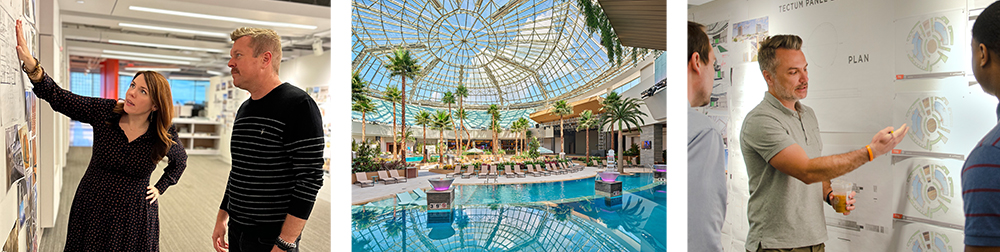 For Emily Marshall, interior design leader, and Thor Harland, senior associate, architecture and design for HBG Design, starting with a blank page before designing a project creates unlimited potential.
“We think about where the space is, the local identity, then how we want the guests to feel,” says Marshall. “What’s the story we want to tell? What’s the property’s identity? Also very important operationally, what’s the flow? And where is the excitement and escape? We start with a concept, and the interior and architecture develop from that.”
“It takes a forensic investigation into things like the site, the climate, the patterns of use, the history, the client,” says Harland, who approaches that journey with “humbleness and openness.”
Placemaking in Tribal Casino Resort Design
“With Native American projects, there’s such a passion for who our clients are and their culture. If we can create an architecture that’s reflective of that, that mimics that—not so much literally, but purposefully, in every design move—it makes for a stronger project,” he says.
“This place-based idea is a journey towards authenticity that is unique to a site and unique to the client. You can’t just pick it up and move it anywhere else, because it wouldn’t function as well. That, for us, is a successful project.”
The work continues “from early concepts through construction documents,” says Marshall. “We’re with the client making decisions on big-picture geometry all the way down to the tile in the guest room. If we can always tie those decisions back to a common thread, it creates a consistency in the design.”
Contextual Design that Enhances Year Round Guest Experience
HBG’s work on the Gun Lake Casino Resort in Wayland, Michigan stands out for Marshall as “one of our finest examples of place-making architecture.” Harland concurs, calling it “one of the best examples of creative, thoughtful depth, from early massing to the materials chosen on the interior. The Gun Lake Tribe was very ambitious, very forward-thinking. They wanted to create something that hadn’t been seen, that was completely new, avant-garde to the area, and make a statement. For us it was important to meet that passion and excitement, and create and carry through that momentum.
“It’s Michigan, with very harsh winters, so the tribe wanted to create an enclosed tropical oasis within.” HBG created an egg-shaped, glass-enclosed atrium, aligned east to west for maximum sun exposure. While dramatic, it’s also functional and can be used for entertainment.
“We created a compelling piece of architecture that’s dynamic and cool to look at,” Harland says. “It also functions better than if we went with just a simple form, like a circle or a square.”
From the first view of a resort rising from the landscape to the smallest details—subtle references to ecology and culture in materials, finishes, color palette, etc.—place-based design tells a story, creating meaningful connections among guests, communities and their shared environment.
Read the full feature Everything in its Place in Global Gaming Business’ Casino Style Magazine to learn more about how context and regional authenticity drive casino resort design.