
Artificial intelligence is at the forefront of technologies streamlining the casino design process.
Nathan Peak, AIA, president of HBG Design, recently contributed insights to the feature article, Friction Free Design, in Global Gaming Business’ Casino Style Magazine.
Nathan says that the introduction of AI technology does not replace the human element in design.
“While AI has increased the speed and options available to us in our ideation process during conceptual design, it has not diminished the importance of authentic, original design by our staff of professional architects and interior designers,” he says.
“It’s imperative that they continue to engage in their own discovery to grow professionally. In this sense, AI is used to enhance, rather than replace, creative processes and is primarily used for brainstorming, research, and illustrating design options, allowing our team to explore more possibilities with clients in a shorter timeframe.
“We view AI as a tool among many, useful for ideation and streamlining tasks, but always requiring human oversight and creative control to maintain the integrity of our work… We lightheartedly talk about AI as ‘almost intelligent.’ It’s strictly a tool. We give it very specific parameters and provide explicit guardrails, never assuming every answer generated is correct. In essence, all AI-assisted results are subject to the same rigorous vetting and review standards as any other project deliverable, ensuring that AI does not replace the team’s QA/QC process.”
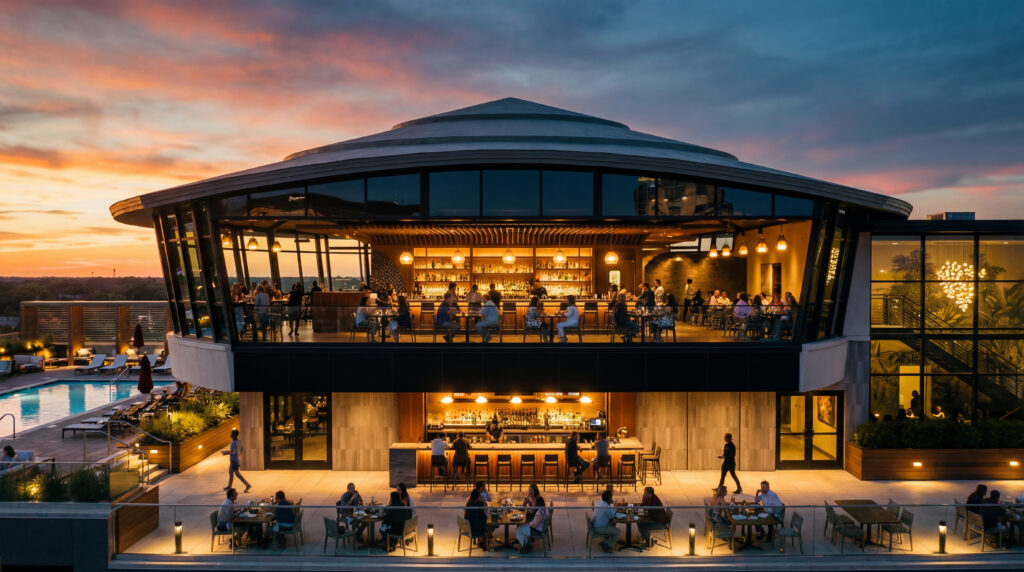
Saving Time
If there’s one thing the AI tool has done, it’s save time, and, with the assistance of other advancing digital technologies, improve efficiency within a given project.
“AI and advancing technologies have shortened project timelines, particularly in the early stages of conceptual design, by enabling rapid assistance in generating design options for client presentations,” says Peak at HBG. “For example, we can now respond with immediate changes to renderings in real time, based on client feedback via AI prompts and scripts.”
Peak adds that AI can map out all details of a project and present a more complete picture to the client. “It gives us an advantage in the speed at which we’re able to illustrate potential solutions our clients are seeking,” he says.
“For instance, if we’re doing a renovation, when it comes to very specific carpet patterns, signage, or a cage design, we can take a photograph of an interior space and combine those visuals with quick sketches and original design narratives using AI, to rapidly combine elements and ideas that our clients can react to much faster than we were able to do previously.
“AI tools enable our teams to start design conversations earlier with our clients without extensive initial data collection. Especially by employing illustrative, image-based AI tools, we can move the design process forward early, before full site measurements are completed, which is more efficient and effective. Data collection is still necessary, but it’s no longer the first step, which accelerates the overall process.”
One of Many Tools
AI and other modern tools have created a casino design discipline that will continue to evolve in years to come.
“We foresee increased efficiency by AI acting as an additional layer of review, freeing up staff for other tasks, and laying the groundwork for more interactive client relationships using collaborative AI tools,” says Peak at HBG.
“That said, we can’t stress the continued reliance on human oversight for quality assurance and validation enough. Our goal is to shape a shared vision with our clients; AI tools provide more opportunity for design professionals to connect with clients. It mobilizes a more collaborative design approach in real time that accelerates our connection to a client’s vision.”
Read the full feature Friction Free Design in Global Gaming Business’ Casino Style Magazine to learn more about how AI is being incorporated as an ideation tool during casino resort design.